Part 1: Lighting Design Fundamentals
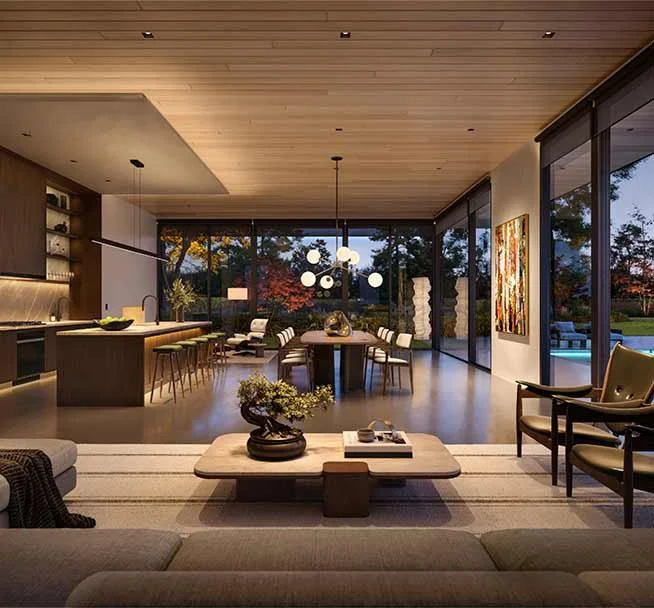
LIGHTING DESIGN FUNDAMENTALSA well-lit room is built in layers.
Each layer has its own job and its own control. Planned together, they let a room feel bright and functional at noon and quiet and intimate at night, without anyone touching more than one button.
Most lighting plans cover four layers. In the homes we work on, there is a fifth, and it is often the brightest light in the room.
-
Ambient light sets the overall brightness of a room so people can move through it comfortably. In luxury residential work this is usually recessed downlights, cove lighting or concealed linear light, rather than a single central fixture.
The goal is even, soft light without glare. Good ambient light is the layer you notice least. It should be dimmable, and in most rooms it should sit well below full output most of the time.
-
Task light is focused on surfaces where people read, cook, dress or work: kitchen counters, islands, desks, vanities, closets and reading chairs.
It needs to be brighter than the ambient layer and placed to avoid shadows. Under-cabinet light, pendants over an island, mirror lighting at a vanity and adjustable reading lights are typical examples. Color quality matters most here, so specify a high color rendering index (CRI 90 or above) wherever skin tones, food or fabric will be judged.
-
Accent light draws the eye. It picks out artwork, sculpture, stone, millwork or a textured wall, and it is what gives a room depth.
Accent light only works through contrast. A common rule of thumb is that the lit object should be about three times brighter than its surroundings to register, and more for a dramatic effect. Adjustable and narrow-beam fixtures, picture lights and wall washers do this work.
-
Chandeliers, pendants, sconces and lamps are seen as much as they are used. Decorative fixtures set the style of a room and add sparkle, but they rarely light it well on their own.
Treat decorative light as part of the design palette, chosen with the interior designer, and put it on its own control so it can glow softly without washing out the other layers.
-
In a home with floor-to-ceiling glass, daylight outshines every fixture in the room for much of the day. It is also the layer that causes the most problems: glare on screens, heat gain, faded fabrics and art, and rooms that feel dark at dusk because the eye has adjusted to the bright windows.
Daylight is controlled by window treatments. Sheer shades and drapery soften it, solar shades cut glare while keeping the view, and blackout layers close a room completely. When shades and drapery are motorized and on the same system as the lighting, daylight becomes a layer you can design and program, just like the other four.
A morning scene can raise the shades and leave the lights off. An evening scene can close the sheers as the accent and decorative layers come up. An afternoon schedule can lower solar shades on the west windows before the sun reaches the art.
-
The layers are only useful if each one can be controlled on its own. That means separate zones for ambient, task, accent and decorative light, and separate shade groups by window orientation. A well-planned keypad then calls up scenes, such as Morning, Dinner, Evening and Night, that set every layer at once.
With a Lutron system, lighting and shades are designed, installed and programmed as one system, so a single keypad, app or schedule controls the whole room.
-
Reflected ceiling plan: every fixture labeled by layer, with a legend that matches the fixture schedule.
Zoning: which fixtures share a control zone, and which window treatments are grouped together.
Keypad locations: placed at entries and beds, with proposed scene names engraved on the buttons.
Window treatment pockets and tracks: recess or pocket dimensions on the ceiling plan, with downlights and wall washers kept clear of the stack-back.
Color temperature and CRI: a consistent color temperature by room, and CRI 90 or above for task and accent light.
Power for motorized treatments: a location for each shade or drapery motor, coordinated before ceilings close.
Plan all five layers with one team.
The Integrated Workroom designs lighting, fabricates custom drapery and programs Lutron controls. Bring us your next project, or book our accredited CEDIA CEU class on lighting design for your firm.